The Trust Flywheel
by Chiqui Escareal-Go


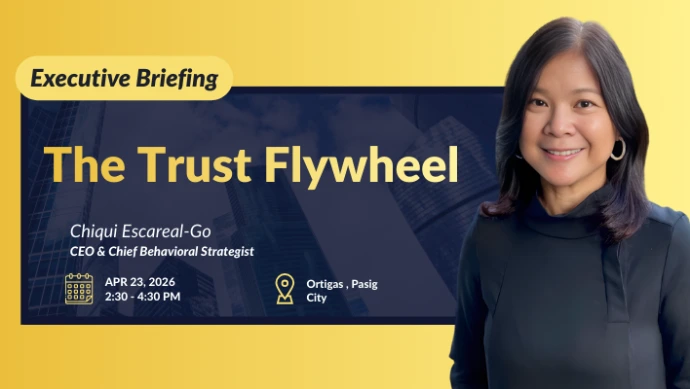
Building High-Trust Organizations: From Culture to Decision Architecture
The Trust Flywheel
The Business Case
Organizations don't stall because of bad strategy. They stall because trust breaks down — and no one can measure it, locate it, or fix it fast enough.
This masterclass changes that. The Trust Flywheel reframes trust from a leadership value into a governance and performance system — one that directly determines decision speed, execution quality, and risk exposure. Participants leave with a diagnostic framework they can apply the following Monday.
What You Will Walk Away With
A working model that explains why high-culture organizations still underperform. A diagnostic for locating exactly where trust is breaking your execution. And a governance response toolkit calibrated to the severity of the failure — not just the symptoms.
Program Outline
Part 1 — The Architecture of Trust
We open with the question executives rarely ask: If your culture is strong, why is execution still slow? The answer lies in the difference between relational trust and executable trust. Participants are introduced to the Trust Flywheel — a three-engine model linking leadership intent (Loob), decision transparency (Tulay), and enforcement credibility (Labas) — and shown how these engines combine to create or destroy organizational momentum.
Part 2 — Diagnosis and Response
Participants run a live diagnostic against their own organizations using observable trust signals. The session maps trust patterns — Warm but Slow, Performative, and Executable — against a four-tier failure model, then matches each failure tier to a calibrated governance response. The session closes with cross-sector case applications and a personal action framework each participant takes back to their organization.
Who Should Be in the Room
CEOs, Presidents, and members of the senior leadership team. Functional and business unit heads responsible for execution. Strategy, transformation, risk, and governance leaders. This is not an HR program. It is a performance and decision architecture program that happens to solve what HR programs cannot.
Why This, Why Now
Trust failures are no longer soft-side problems — they are balance sheet problems. They show up as delayed decisions, misaligned execution, talent attrition, and governance exposure. The leaders who treat trust as an operational variable rather than a cultural aspiration are the ones closing the gap between strategy and results.
"The organizations winning today are not the ones with the best values posters. They are the ones where trust is built into how decisions are made and enforced."
Format: 2-hour executive briefing | Conceptual framework + live diagnostics + applicable tools
Suitable for: In-company delivery, executive retreats, leadership conferences, and public program cohorts
(Note: To maximize learning, the class size is limited. Please apply early.)
Who Should Attend
C-Suite Executives:
CEO, CFO, COO, CIO, and etc.
Schedule & Location
April 23, 2026 (Friday) 2:30 - 4:30 PM
Ortigas, Pasig City
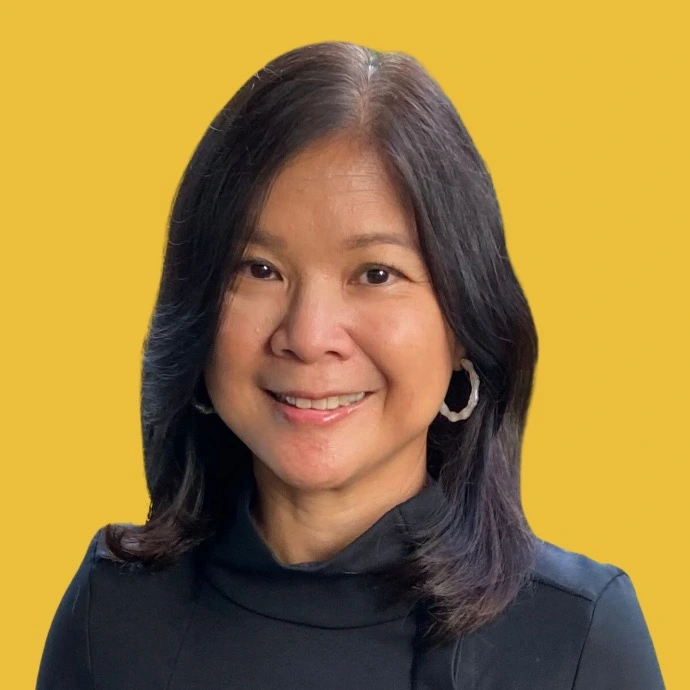
SPEAKER
Chiqui Escareal-Go
CEO and Chief Behavioral Strategist
- Mansmith and Fielders Inc. is the first and only private company recipient of the Agora Award for Nation Building in Market Leadership.
Author/Co-Author/Editor if 10 books in marketing, entrepreneurship and anthropology
Finished the Advanced Management Program 2018 (IESE Business School New York and Barcelona)
Executive Scholar in Marketing and Sales (Kellogg Business School, Northwestern University)
Took advanced marketing programs at Columbia Business School (CEIBS campus), Harvard Business School, University of California-Berkeley
Certified Master Coach (by the Behavioral Coaching Institute) and Certified Appreciative Inquiry Training Facilitator (by Company of Experts USA)
Go Negosyo Enabler Awardee 2014; ASEAN Women Entrepreneurs Network Awardee 2015
Former Chair of the Women’s Business Council Philippines
M.A. in Anthropology, University of the Philippines / M.A. in English Language and Literature Teaching, Ateneo de Manila University